Top 10 Natural Flocculants You Should Know About?
In the world of wastewater treatment and environmental management, the role of Natural Flocculants is vital. Dr. Jane Thompson, a leading expert in environmental science, once noted, "Natural Flocculants can transform how we approach water purification." These substances, derived from natural sources, offer an eco-friendly alternative to synthetic options.
Natural Flocculants enhance the aggregation of particles in water, making the purification process more efficient. They can reduce harmful chemicals in our ecosystem. With an urgent need to address water quality issues, understanding various Natural Flocculants is crucial.
Exploring their benefits is essential. However, not all Natural Flocculants are equally effective. Some may require certain conditions to function optimally. As we delve into the top ten Natural Flocculants, we'll examine their specific properties and potential drawbacks. This insight will guide us in making informed decisions for sustainable practices.
Understanding Natural Flocculants and Their Importance in Filtration
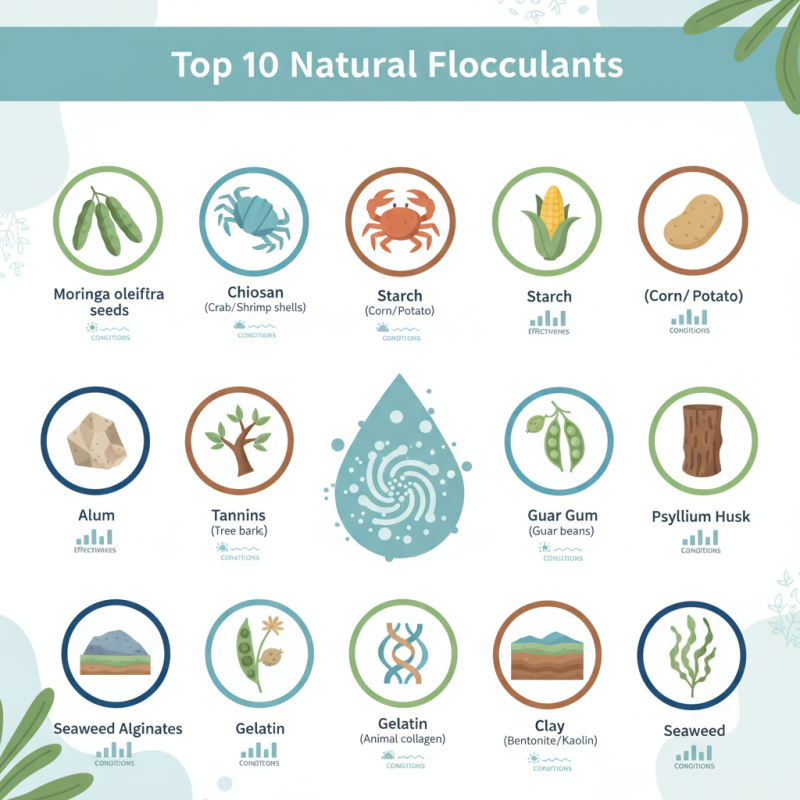
Natural flocculants play a crucial role in the filtration process. These substances help aggregate particles, allowing for easier removal from liquids. They are derived from various organic sources, making them an eco-friendly alternative to synthetic options. Common examples include starch, chitosan, and aloe vera. These materials bind with suspended particles, forming larger clusters. This enhances clarity and purity in filtered water.
When considering natural flocculants, it is essential to evaluate their effectiveness. Some may work better in specific pH levels or temperatures. Experimenting with different flocculants can yield better results. Not all flocculants produce the same outcomes; results can vary based on the water source. A flocculant's performance may be influenced by its concentration and the type of contaminants present.
Tips: Try combining different natural flocculants for improved results. Monitor the filtration process closely. Adjust the mixing times and techniques as needed. Remember, each water type may react differently. Regularly re-evaluate your selection for efficiency. Balancing effectiveness and environmental impact is vital.
Top 10 Natural Flocculants in Filtration
This chart illustrates the effectiveness of the top 10 natural flocculants based on their average turbidity removal percentage in water filtration. The data showcases the importance of these natural agents in enhancing water quality.
Overview of Common Types of Natural Flocculants and Their Sources
Natural flocculants are essential for various applications, especially in water treatment. Common sources include plants, algae, and even some animal products. These agents help gather particles together, making them easier to remove.
Some of the most widely used natural flocculants come from sources like Moringa seeds and seaweed. Moringa seeds have proteins that interact with impurities. Seaweed contains polysaccharides that can form gels. Other options include chitosan, derived from crustacean shells. It’s effective but may not be suitable for all users due to allergies.
Experimentation with natural flocculants can lead to inconsistent results. Factors like concentration, particle size, and pH can affect effectiveness. It’s not always straightforward. Sometimes, the expected results don’t materialize. Understanding these variables can be a challenge and requires deeper exploration.
Mechanisms of Action: How Natural Flocculants Facilitate Sedimentation
Natural flocculants play a crucial role in sedimentation. Understanding their mechanisms of action can lead to more effective applications. These substances act by neutralizing charges. When particles carry the same charge, they repel each other. Flocculants promote aggregation, allowing suspended solids to clump together.
It's fascinating how natural ingredients like starch or chia seeds can achieve this. Starch granules can swell in water, forming a gel-like substance. It binds with particles, facilitating their descent. Chia seeds release mucilage, enhancing sedimentation similarly. The process improves clarity in various liquids.
Tips: Remember to test various natural flocculants. Not all work the same for every application. Observation is key. The effectiveness may vary with temperature and pH levels. Also, consider the sources of your natural flocculants. Sustainability is important for long-term use. You might find unexpected results that lead to better solutions.
Top 10 Natural Flocculants You Should Know About
| Flocculant |
Source |
Mechanism of Action |
Applications |
| Chitosan |
Crustacean shells |
Positively charged, binds to negatively charged particles |
Water treatment, food industry |
| Moringa Oleifera |
Seeds |
Encapsulates and neutralizes particles |
Drinking water purification |
| Algal Biomass |
Microalgae |
Cells aggregate and settle |
Wastewater treatment |
| Starch |
Plants (corn, potatoes) |
Forms a gel that traps particles |
Paper manufacturing, wastewater |
| Gelatin |
Animal collagen |
Acts as a glue to aggregate particles |
Food, pharmaceuticals |
| Pectin |
Fruits |
Forms gels with sugar and acid |
Food, beverages |
| Tannins |
Plant materials |
Bind and precipitate proteins |
Water treatment, wine production |
| Sodium Alginate |
Brown seaweed |
Form viscous solutions to trap solids |
Food, cosmetics |
| Cationic Polymers |
Synthetic derivatives |
Charge neutralization and bridging effects |
Water treatment, papermaking |
Applications of Natural Flocculants in Water Treatment and Agriculture
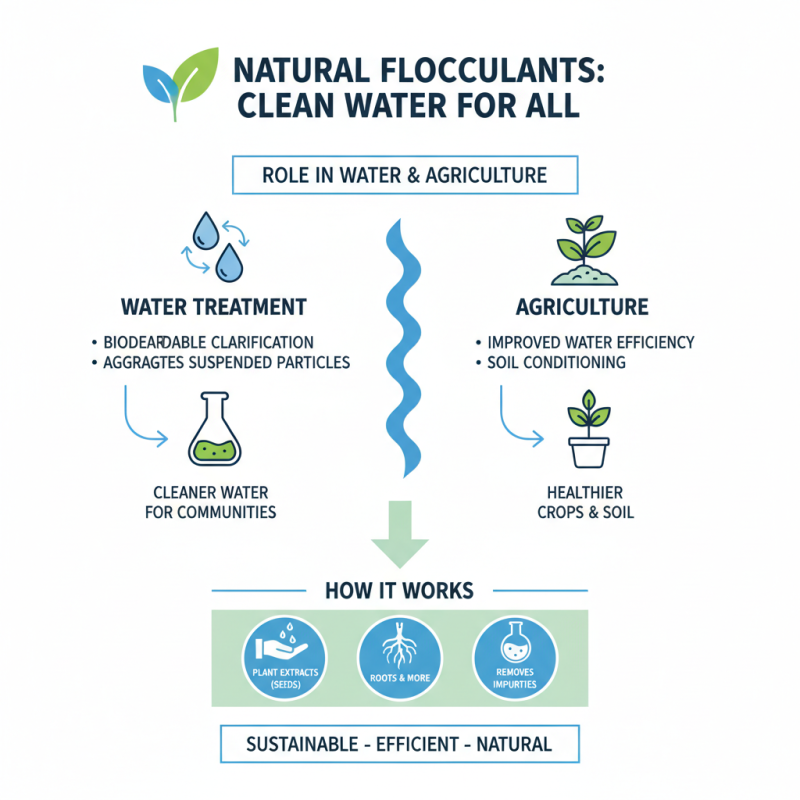
Natural flocculants play a pivotal role in water treatment and agriculture. These biodegradable substances help in clarifying water by aggregating suspended particles. Common examples include various plant extracts, such as those from seeds and roots. They can efficiently remove impurities from water, leading to cleaner resources for communities.
In agriculture, natural flocculants enhance soil structure. They improve water retention and nutrient availability. Farmers can see increased crop yields through better soil health. However, not all natural flocculants are equally effective. Some may not work well in certain soil types. Careful testing is crucial to find the right flocculant for specific conditions.
The application of natural flocculants may seem straightforward, but outcomes can vary. Environmental factors greatly influence their effectiveness. As farmers and water treatment facilities continue to explore these options, it's essential to remain open to adjustments. Success might require multiple attempts to optimize results. Embracing a flexible mindset can lead to innovative solutions in both fields.
Evaluating the Effectiveness and Environmental Impact of Natural Flocculants
Natural flocculants have gained traction in environmental science. Their role in water treatment is crucial. They help in the aggregation of suspended particles. This leads to clearer water. A study by the Environmental Protection Agency indicates that natural flocculants can reduce turbidity by up to 90%.
Evaluating their effectiveness requires understanding various factors. The type of flocculant, its source, and application method all play a role. For instance, materials like chitosan or plant extracts can vary widely in efficiency. Some might work well in certain conditions but fail in others. This inconsistency raises questions regarding their general applicability.
Moreover, the environmental impact of using natural flocculants isn't fully understood. While they are biodegradable, sourcing materials can disrupt local ecosystems. Overharvesting can lead to biodiversity loss. According to a recent report, there's a gap in data concerning sustainable harvesting practices. These complexities warrant a careful approach when utilizing natural flocculants. Balancing effectiveness and environmental stewardship is not straightforward.