How to Choose the Right Polyacrylamide Gel for Your Needs?
Choosing the right polyacrylamide gel is crucial for various applications in laboratories. This material is widely used in biochemistry and molecular biology for electrophoresis. Understanding its properties helps to select the suitable concentration, pore size, and gel composition.
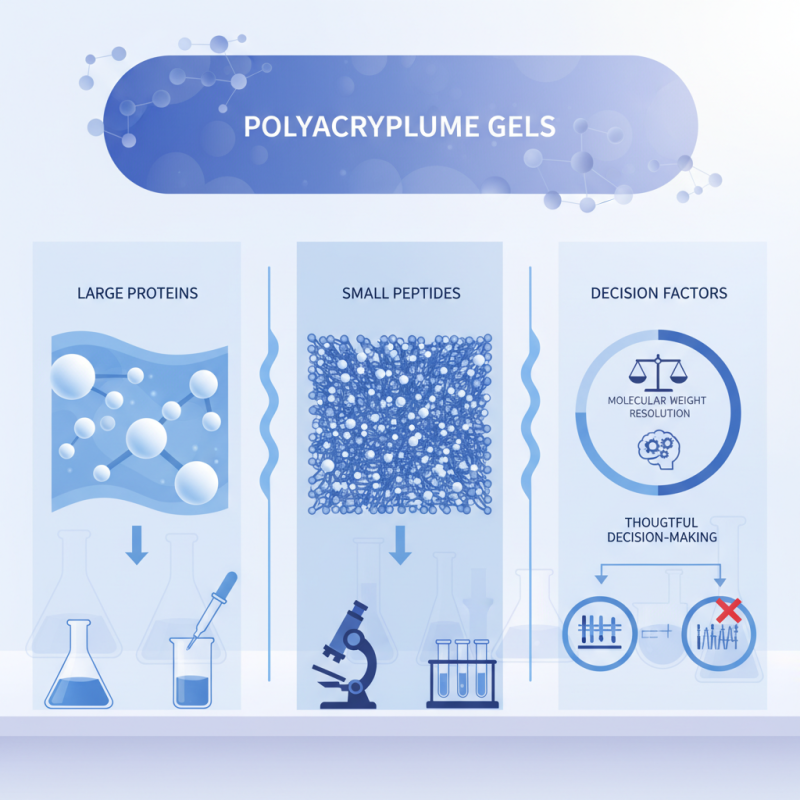
Different experiments require specific types of polyacrylamide gels. For instance, low concentration gels are ideal for larger proteins, while higher concentrations work better for small peptides. Certain details can impact the final results of your assays. Each application may bring unique challenges that a researcher must navigate.
The impact of gel choice on your experiments cannot be overlooked. A mismatch can lead to poor separation or unsatisfactory results. It’s essential to assess the needs of your specific project carefully. Evaluate the molecular weight of the samples and the required resolution. This thoughtful decision-making process is key to achieving reliable results in your experiments.
Understanding Polyacrylamide Gel and Its Applications
Polyacrylamide gel is an essential tool in molecular biology. It is widely used for protein and nucleic acid separation. Researchers often rely on its unique properties to achieve specific results in experiments. The gel combines acrylamide and bis-acrylamide to form a network structure, offering high resolution in separating biomolecules. This structure can be tailored by adjusting the concentration of acrylamide.
Different applications utilize various pore sizes in polyacrylamide gels. For example, a higher concentration is suitable for smaller proteins. Conversely, lower concentrations work well for larger molecules. Understanding the desired resolution is crucial when choosing the right gel. Mistakes in this choice can lead to suboptimal separation and unreliable data.
While polyacrylamide gels provide numerous advantages, they also have limitations. Handling and polymerization can be tricky and require precise conditions. Additionally, gels are usually fragile and may need careful storage. These aspects remind researchers to reflect on their practices. Balancing accuracy in results with operational challenges is key in successful experiments.
Types of Polyacrylamide Gels: Choosing the Right Type for Your Experiment
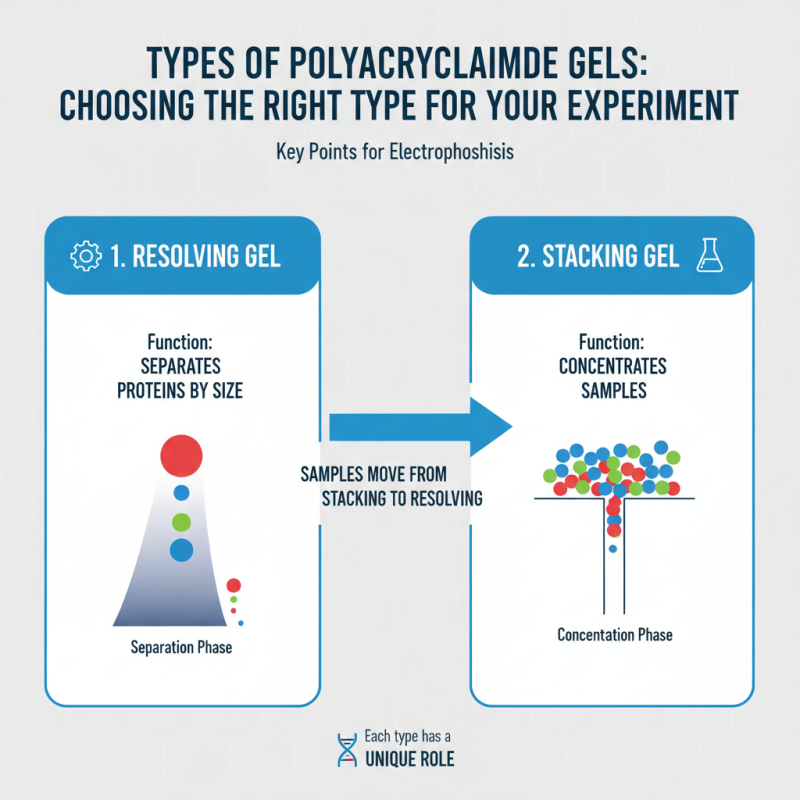
When selecting a polyacrylamide gel for your experiment, understanding the different types is essential. There are two primary types: resolving gels and stacking gels. Resolving gels separate proteins based on size, while stacking gels focus on concentrating samples before they enter the resolving phase. Each type serves a unique role in electrophoresis.
The gel percentage and composition matter significantly. Lower percentage gels, about 5-7%, are suitable for larger proteins. In contrast, higher percentage gels, roughly 10-15%, work best for smaller proteins. The pH and buffer system also influence the gel's effectiveness, impacting resolution and migration speed.
Experimentation is crucial when choosing the right gel. Sometimes, the initial choice might not yield expected results. Adjusting gel concentration or buffer conditions can be necessary. Keep detailed notes on your experiments to identify what works best. Reflecting on these variations can help refine your approach and enhance your research outcomes.
Factors to Consider When Selecting Polyacrylamide Gel Concentration
When selecting polyacrylamide gel concentration, several factors come into play. The gel's concentration affects the separation of proteins during electrophoresis. Higher concentration gels (10% to 15%) are suitable for smaller proteins, while lower concentrations (5% to 8%) work best for larger proteins. Reports show that effective separation ranges between 5% and 15%, depending on the protein's molecular weight.
It's essential to consider the sample type. For instance, if working with complex mixtures, a gradient gel may provide better resolution. Moreover, the choice of buffer system also impacts the gel's performance. Sodium dodecyl sulfate (SDS) is commonly used, but alternative buffers may be needed based on specific applications.
Tip: Always prepare a calibration curve with known protein standards. This ensures your gel is properly set up for accurate results. Another idea is to test different concentrations with a pilot study. This approach helps refine your technique and improve your outcomes. Each experiment can reveal insights into appropriate gel settings, leading to better overall performance in your analyses.
How to Choose the Right Polyacrylamide Gel for Your Needs? - Factors to Consider When Selecting Polyacrylamide Gel Concentration
| Gel Concentration (%) |
Application |
Molecular Weight Range (kDa) |
Usage Notes |
| 5% |
Protein Separation (Large Proteins) |
>250 kDa |
Best for large protein complexes. |
| 8% |
General Protein Separation |
100-250 kDa |
Commonly used for moderate-sized proteins. |
| 10% |
Fine Protein Separation |
50-100 kDa |
Ideal for separating small to medium proteins. |
| 12% |
Nucleic Acid Separation |
5-50 kDa |
Suitable for separating DNA and RNA fragments. |
| 15% |
High-Resolution Separations |
<50 kDa |
Best for very small proteins and peptides. |
Interpreting Gel Electrophoresis Results: The Role of Polyacrylamide
Gel electrophoresis is a powerful technique widely used in biochemistry and molecular biology. Polyacrylamide gels are often favored for separating proteins and nucleic acids due to their adjustable pore sizes. The choice of gel concentration directly impacts resolution and separation quality. Higher concentrations lead to smaller pores, suitable for separating smaller molecules. Conversely, lower concentrations allow larger molecules to pass through, enhancing separation efficiency for bigger proteins.
Interpreting the results of gel electrophoresis requires a careful analysis of band sizes and intensities. Clear bands indicate the successful separation of samples. Faint bands might suggest low concentrations or degradation. Observing unexpected band patterns can lead to further investigation. It's essential to maintain proper controls in experiments for reliable comparisons. Knowing the molecular weight standards helps in accurately estimating the size of your target molecules.
While gel electrophoresis is a reliable method, it is not infallible. Variability in sample preparation, gel casting, and running conditions can affect results. Scientists often need to repeat experiments to ensure consistent findings. Regular calibration of equipment can also minimize errors. A reflective approach to these inconsistencies enhances the credibility of your results, fostering continuous improvement in your research methods.
Handling and Storing Polyacrylamide Gels for Optimal Performance
Proper handling and storage of polyacrylamide gels is crucial for achieving optimal performance in laboratory settings. These gels are sensitive to temperature and humidity changes. Exposure to extreme conditions can lead to decreased effectiveness. Laboratory studies indicate that gels should be stored at low temperatures, ideally between 4°C and -20°C. This helps maintain their integrity for longer periods.
Moreover, avoid repeated freeze-thaw cycles. Research shows that each cycle can reduce a gel's performance significantly. For instance, a study revealed that a single freeze-thaw cycle can lead to up to 30% loss in resolution. Clearly, improper handling not only affects outcome reliability but can result in wasted resources.
Labeling gels with the preparation date and intended use can enhance tracking. This small step prevents using outdated gels. In some labs, people ignore this practice, leading to inconsistent results. Regular training sessions focusing on handling techniques could improve overall lab standards. It's essential to cultivate a culture of awareness around gel storage to ensure the validity of experimental results.